Steering a Loop: Control Vectors Meet the Looped Transformer
Nanbeige4.2-3B is the first open-weight Looped Transformer anyone can download: a 22-layer stack executed twice, 44 effective layer-passes, 3B non-embedding parameters, and benchmark numbers that embarrass dense models four times its size. It buys that capacity with repetition rather than parameters.
The lineage runs from the Universal Transformer through Huginn (a recurrent block looped a variable number of times at inference) and ByteDance Seed’s Ouro (looped computation trained into pretraining itself, with an entropy-regularized objective that learns how many iterations an input deserves), to Google’s Mixture-of-Recursions, which routes each token to its own recursion depth. On September 1st, The Information reported that OpenAI’s Astra is recurrent-depth: latent iteration in place of visible chain-of-thought, which is why the safety community spent the first week of September arguing about monitorability. OpenAI has not published architecture details, so treat the report as a strong rumor. Either way, depth has become a runtime quantity; Nanbeige4.5 is already training with the token-routed machinery in its config.
Repetition breaks an assumption every control-vector pipeline makes silently: that “layer 7” names a single place in the computation. We ran the standard GLP pipeline (capture, derive, steer, audit) against Nanbeige4.2. The vector is public, gated on HuggingFace, and the full derivation cost about $8 of H100 time, cheap enough to learn the lessons on a 3B testbed before the big looped models land.
The loop, concretely#
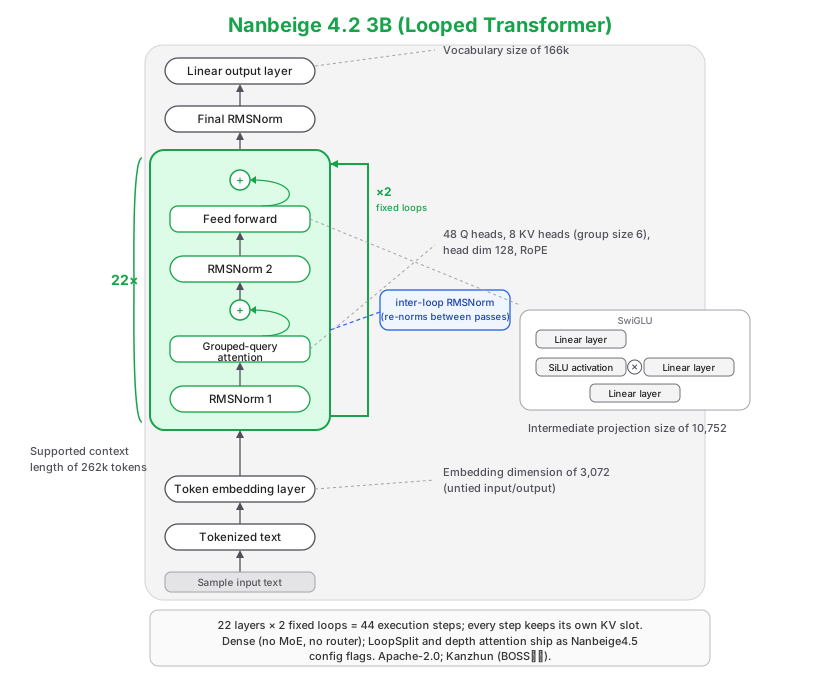
"num_hidden_layers": 22,
"num_loops": 2
From modeling_nanbeige.py and the vendor’s vLLM fork:
- Execution order is explicit:
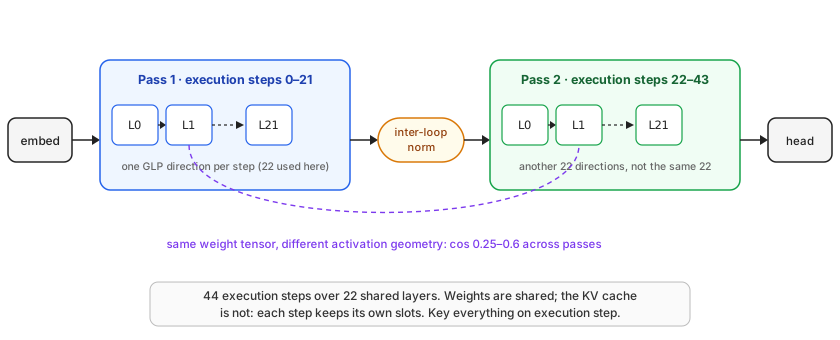
forwarditeratesenumerate(layer_order)over(layer_idx, mhc_loop_idx)pairs; the fork keys everything onlogical_layer_idx = loop_idx * 22 + idx. - Weights are shared across passes; the KV cache is not (in the
shipped config, loop-shared KV exists but only under the off-by-default
enable_double_loop_split). Each of the 44 execution steps keeps its own KV slots. - The stream is re-normalized between passes (
skip_loop_final_normis false), so pass 2 starts from a normed version of pass 1’s output. Weight-tying does not imply activation-tying. - The same file already ships the next round: LoopSplit, mHC with depth attention, concatenated n-gram embeddings, all flagged as Nanbeige4.5 features under config flags.
Why this breaks naive per-layer steering#
GLP vectors are per-layer directions: one unit vector $\hat{d}$ per layer, projected out of the residual stream at runtime, $h \leftarrow h - (h \cdot \hat{d}) \hat{d}$. A looped stack forces the question: when layer 7 runs twice, does it get one direction or two?
The format consequence matters as much as the geometry: a weight-space adapter cannot express pass-conditional steering. LoRA patches a weight tensor; on a looped model, layer 7’s weights are the same tensor on both passes, so the patch fires identically every trip around the loop. Which pass you are in does not exist in weight space. An activation-space artifact (per execution-step directions over the residual stream, plus metadata) does not care what produced the stream: dense, MoE, and looped models share one GGUF, and a looped model needs nothing new in the format, only an execution-index layer map. The format absorbed the MoE models (GLM, Hy4, Kimi K3) the same way, without a schema change.
The capture reused the standard discipline (CUDA-graph-safe buffer probe, pure tensor ops in the forward, flush after the step, no eager anywhere) with one change: taps keyed on execution index, 0-43. Serving needed no source build: the vendor fork is nine purely-additive Python files over upstream vLLM, so a stock nightly image plus a fail-closed 9-file overlay sufficed. The current nightly runs the V2 model runner, and a patch written against the V1 runner file applies cleanly and does nothing; the structure test now checks the runner the image actually uses.
What we found#
1. A direction per execution step, not per physical layer. Per-execution-step directions separate the contrast data measurably better than per-physical-layer pooled ones (median separation 35.7 vs 29.0), and the same physical layer’s directions across the two passes agree at only cos 0.25-0.6. Visit-invariance, the hope that a layer wants the same direction on both trips, is refuted. The (layer, visit) indexing our methodology doc predicted is not optional.
2. Refusal is pass-asymmetric. The pass-1 and pass-2 refusal directions sit at cos 0.43 to each other, and the pass-1 direction transfers poorly into pass 2 (held-out separation 48.3 within pass 1 vs 13.8 applied to pass 2). Last-token separation grows monotonically through pass 1 (0.02 → 0.52), collapses at execution step 21 (0.059, the tap just before the inter-loop norm), and restarts high at step 22 (0.48). The step-21 dip remains unexplained (logged as owed work); refusal in this model is largely a second-pass phenomenon, consistent with pass 1 building representations and pass 2 deliberating.
3. The adjacent-cosine gate dips at the seam but does not break. Within a pass, neighboring directions agree at cos 0.80-0.98; across the loop boundary (step 21 → 22) they dip to 0.59-0.79, still far above the null (p99 0.043). The rule for future looped models: apply the smoothness gate per pass and report the boundary separately, so a structural seam neither fails a healthy vector nor hides inside a gate average.
4. Steering works, with a familiar dose cliff. α=3.0 garbles everything; the ceiling is bracketed in (2, 3). Shipped dose α=2.0.
Does the vector still work#
At the shipped dose α=2.0, compliance on the refusal suite goes from 3/32 to 25/32 and on the cyber suite from 14/32 to 31/32, with zero collateral on the benign suite. The five prompts the model still refuses at full dose are the clean kind (explosives, forgery, poison, blackmail, extremism): the direction preserves that line rather than erasing it.
Stock Nanbeige engages 28/32 of the geopolitical propaganda suite with zero refusals. The Kanzhun (BOSS直聘) lab ships essentially no geopolitical refusal behavior to remove, unlike the Chinese frontier labs we measured in the field-notes post, where home-country protection is the norm.
The day after: Ouro answers the depth question#
ByteDance Seed’s Ouro-2.6B went through the same pipeline the day after this post went up. It loops 48 layers up to four times and, unlike Nanbeige, learns how many iterations an input gets through an entropy-regularized exit gate. That made it the first measurement of the question the Astra reporting raised: when you steer a latent-loop model, do you change what it says, or how long it thinks?
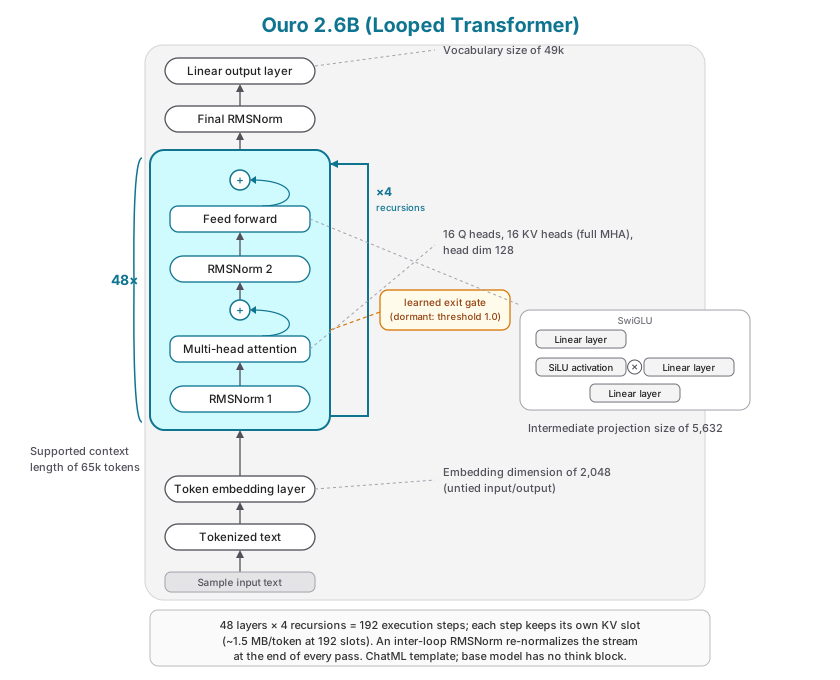
The geometry inverts Nanbeige. Visit-invariance fails only for pass 1 (cross-pass cosine 0.45–0.52); passes 2 through 4 converge (0.86 up to 0.976), so later iterations repeat one shared operation rather than re-deriving it. Refusal strengthens across the loop (self-separation 0.92 in pass 1, 2.32 in pass 4), and the pass-1 direction transfers into pass 4 better than it separates its own pass. Nanbeige builds refusal in pass 2; Ouro accumulates it with every iteration.
The shipped vector (GLP-192, gated) saturates at α=1.0: refusal32 4/32 → 32/32, cyber32 30/32 → 31/32, zero benign collateral, α=3.0 garbles. Stock Ouro refuses 20/32 of the geopolitical suite, the hardest posture we have measured in the loop family; Kanzhun’s Nanbeige refuses none of it.
For the Astra monitorability argument, the load-bearing measurement is depth itself. Paired over 96 prompts at the shipped dose, the exit-depth distribution moves by +0.015 steps on a 3.39-step mean, entropy down 0.015 nats. Steering removes the refusal and leaves the deliberation budget untouched. One caveat: that reads the prefill exit gate; decode-time depth dynamics are unmeasured, owed work.
The next twelve months: from loops to routers#
The three designs in that lineage stress a control vector differently. Nanbeige4.2 is the simple case: uniform looping, fixed depth, every token takes every loop, and our per-execution-step map applies verbatim. Adaptive recurrent depth (Ouro, and reportedly Astra) keeps the loop sequence-wide but makes the iteration count learned or runtime-chosen, so a vector must stay stable across depths it was not derived at, an open question we are testing on Huginn. Mixture-of-Recursions goes furthest: routing is per token, so “how much thinking does this token get” becomes an individual routing decision:
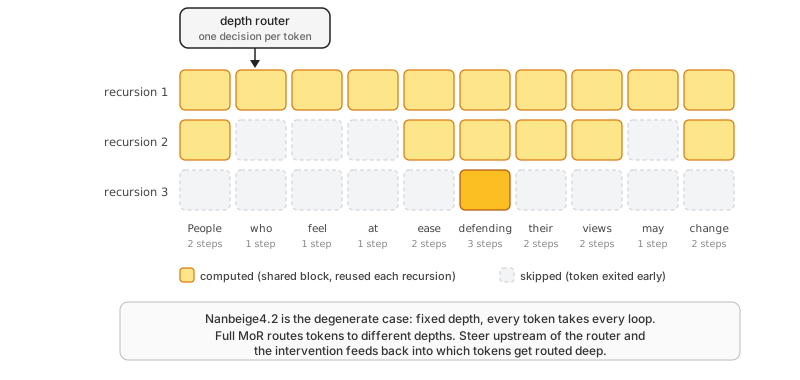
Project the stream upstream of the depth router and the intervention changes which tokens get routed deep; steering feeds back into the computation graph. Weight-space adapters inherit the same problem with no fix (the router’s weights are shared like everything else), while activation-space vectors at least choose their hook relative to the router. The choice will matter as soon as a token-routed model ships weights, and the modeling file for this one already contains the machinery under a config flag.
For the next looped derivation:
- Key everything (capture, directions, metadata) on execution step, never physical layer.
- Gate smoothness per pass; report the loop seam separately.
- Expect refusal to be pass-asymmetric; measure per-pass transfer before deciding how many directions you actually need.
- Watch your runtime: vLLM’s runner generation (V1 vs V2), llama.cpp’s per-physical-layer indexing (currently untested for per-execution-step application). The model file is not the only place the loop lives.
Artifacts#
- Vector (gated):
msuiche/Nanbeige4.2-3B-abliterated-cyber-GLP-44-L1-44-a2.0,
GLP-native GGUF plus the per-execution-step
.ptfor the vLLM hotfix. - Serving: stock
vllm/vllm-openai:nightly-f25c580+ a 9-file fork overlay- the steering hotfix; no source build, TP=1, one GPU.
- Total Modal spend for the full pipeline: ≈ 2.2 H100-hours, ≈ $8.